Ninja Mega Kitchen System BL770: A Practical Look at This All-in-One Blender and Processor
Introduction
There’s a particular kind of kitchen frustration that comes from owning several single-purpose appliances that each do one thing well but together take up an entire cabinet. A blender for smoothies, a food processor for chopping and dough, personal cups for on-the-go drinks — it adds up fast, both in terms of cost and the sheer amount of counter and storage space required to keep them all accessible.
Combination appliances were developed specifically to address that accumulation problem, aiming to fold several distinct kitchen tools into a single motor base with interchangeable attachments. The idea is that one sufficiently powerful motor, paired with the right set of containers and blades, can reasonably substitute for what would otherwise be two or three separate machines. The Ninja Mega Kitchen System BL770 falls into this category, combining blending and food processing functions around a single 1500-watt base. This article offers an independent, educational look at what the system includes, how it’s put together, and what might be worth thinking through before it becomes a fixture in your kitchen.
Product Overview
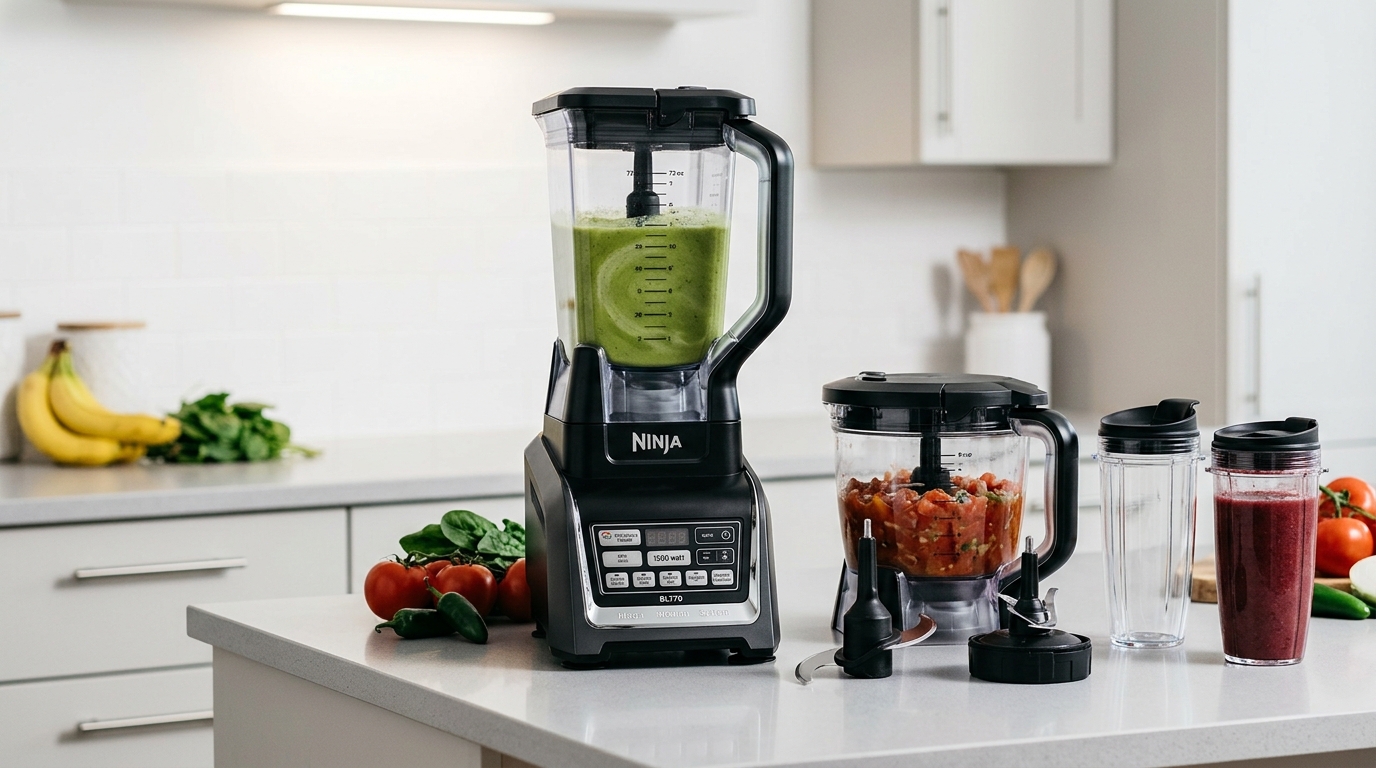
The Ninja Mega Kitchen System is built around a single 1500-watt motor base designed to power multiple attachments rather than functioning as a single-purpose blender. The set includes a 72-ounce pitcher intended for smoothies, frozen drinks, and other blended beverages, alongside an 8-cup food processor bowl designed for tasks like chopping, salsa-making, and dough preparation.
Also included are two 16-ounce cups, which appear to be intended for smaller, single-serving blending tasks separate from the larger pitcher. Finished in black, the system is designed around the idea of a single motor base serving several distinct kitchen functions, reducing the need for multiple standalone appliances performing similar but separate jobs.
Its core purpose is to consolidate blending and food processing capabilities into one countertop system, aimed at households that want the versatility of several kitchen tools without the added expense and storage burden of purchasing and keeping each one separately.
Key Features
1500-Watt Motor Base
At the center of the system is a 1500-watt motor, designed to provide enough power to handle a fairly wide range of tasks across its different attachments — from crushing ice in the pitcher to processing dough in the food processor bowl. A motor in this wattage range is generally intended to support more demanding blending and processing tasks than lower-powered combination systems.
72-oz Blending Pitcher
The included 72-ounce pitcher is designed for larger-batch blending tasks like smoothies, frozen drinks, and other beverages that benefit from a bigger capacity. This size may be particularly useful for families or gatherings where multiple servings are needed from a single blending session.
8-Cup Food Processor Bowl
Beyond blending, the system includes an 8-cup food processor bowl, designed for tasks that fall outside typical blender capabilities — chopping vegetables, making salsa, or mixing dough. This attachment is intended to extend the system’s usefulness well beyond beverages and into more general food preparation.
Two 16-oz To-Go Cups
The inclusion of two smaller 16-ounce cups is designed to accommodate single-serving blending tasks, such as individual smoothies or shakes, without requiring the larger pitcher to be used and cleaned for a smaller portion.
Single Motor Base, Multiple Attachments
Rather than being a single fixed appliance, this system is built around one central motor base that different containers attach to, depending on the task at hand. This design is intended to reduce the overall footprint compared to owning a separate blender and food processor, since only one motor unit needs to be stored, while the various bowls and cups can typically be nested or stacked more compactly.
Dough and Salsa Processing Capability
The food processor attachment is specifically designed to handle denser or chunkier preparations like dough and salsa, tasks that a standard blender pitcher generally isn’t well suited to handle on its own.
Materials and Design
The system’s black finish is designed to offer a neutral, functional appearance intended to blend into most kitchen color schemes without drawing significant attention. Given the number of components involved — the motor base, pitcher, food processor bowl, and two smaller cups — the overall design leans toward practicality, with an emphasis on how the various pieces fit together and store relative to one another.
The motor base itself is built to be more substantial than what’s typically found in single-purpose personal blenders, reflecting the 1500-watt power output and the need to support multiple types of attachments across different tasks. The pitcher and food processor bowl are generally constructed from durable, BPA-free plastic materials, chosen for their ability to withstand both blending tasks involving ice and processing tasks involving denser ingredients like dough.
The blade assemblies differ between attachments, since blending and food processing require different blade geometries to perform effectively. The pitcher typically uses blades designed for pulling liquid and ice through a vertical blending motion, while the food processor bowl uses blades designed for chopping and mixing in a wider, shallower container.
Performance
Performance in a combination system like this depends heavily on which attachment is in use, since blending and food processing rely on different mechanical approaches even when powered by the same motor base. The 1500-watt motor is designed to provide enough power to support both tasks reasonably well, though how demanding a given task is — crushing ice versus kneading dough, for instance — can still affect how the system performs in practice.
The 72-ounce pitcher is designed to handle larger blending batches, and its performance will generally depend on factors like how full it is and the ratio of liquid to solid or frozen ingredients used. The food processor bowl, by contrast, is intended for tasks that don’t require liquid at all, such as chopping vegetables or working dough, where performance depends more on ingredient quantity and consistency than on liquid ratios.
As with most multi-attachment kitchen systems, results can vary depending on how closely a specific recipe or task aligns with what each attachment was actually designed to do. Using the food processor bowl for dense dough, for example, is a different performance scenario than using the blending pitcher for a smoothie, even though both rely on the same underlying motor.
Common Uses
This type of all-in-one blending and processing system is generally suited for:
- Family-sized smoothies, using the 72-ounce pitcher to prepare multiple servings in a single blending session.
- Individual shakes or drinks, using one of the two 16-ounce cups for smaller, single-serving portions.
- Homemade salsa or dips, using the food processor bowl to chop and combine ingredients like tomatoes, onions, and peppers.
- Bread or pizza dough preparation, using the food processor attachment for mixing and kneading tasks that a standard blender pitcher isn’t designed to handle.
- Chopping vegetables for meal prep, using the food processor bowl as a faster alternative to manual chopping for larger quantities.
- Frozen drinks and desserts, using the pitcher’s motor power to process ice alongside other ingredients.
Advantages
- Combined blending and processing capability: Having both a large pitcher and a food processor bowl on one motor base may reduce the need for two separate appliances.
- Strong 1500-watt motor: This power level is designed to support a wider range of tasks, from ice crushing to dough mixing, than lower-wattage systems might handle as effectively.
- Flexible container options: The combination of a 72-ounce pitcher, an 8-cup processor bowl, and two 16-ounce cups is designed to accommodate a range of batch sizes, from single servings to larger family portions.
- Space-conscious design: Using a single motor base for multiple attachments may take up less overall storage space than owning a separate blender and food processor.
- Everyday versatility: Beyond smoothies, the system’s food processing capability extends its usefulness into general meal prep tasks like chopping and dough-making.
- Practical for varied household needs: The range of included containers may suit households with different needs on different days, from a quick personal shake to a larger batch of salsa for guests.
Things to Consider
A handful of practical points are worth reviewing before purchasing:
- Managing multiple components: With a motor base, pitcher, processor bowl, and two cups, there are more individual pieces to store, track, and clean compared to a single-purpose blender.
- Learning curve across attachments: Switching between blending and food processing tasks may require some initial familiarity with which attachment and blade setup is appropriate for a given job.
- Counter and storage space: Even though the system consolidates functions into one motor base, the collection of attachments as a whole still requires a reasonable amount of storage space when not in use.
- Cleaning multiple parts: Depending on how many attachments are used in a given session, cleanup may involve washing several components rather than just one pitcher or cup.
- Personal texture and consistency preferences: As with any blending or processing appliance, results can vary based on ingredient prep and personal expectations for texture, whether that’s a smoothie’s consistency or how finely chopped salsa ingredients turn out.
Comparison with Similar Product Categories
Compared to owning a separate standalone blender and food processor, a combination system like this one is generally designed to consolidate both functions around a single motor base, which may reduce overall appliance cost and storage needs, though it also means relying on one motor for a broader range of tasks rather than having equipment specifically dedicated to each job.
Compared to personal blenders, this system offers considerably more versatility through its food processor attachment and larger pitcher capacity, though personal blenders remain more compact and portable for those who mainly want single-serving drinks without additional processing capability.
Compared to dedicated food processors, the processing capability included in a combination system like this is generally designed to cover common tasks like chopping and dough-making, though standalone food processors sometimes offer more specialized attachments or larger capacities for those who process food more frequently or in greater volume.
Compared to other combination blender-processor systems on the market, differences typically come down to motor wattage, pitcher and bowl capacity, and the number of additional cups or attachments included, which can affect how well a given system matches a household’s specific mix of blending and processing needs.
Maintenance and Care
Maintaining a multi-attachment system like this one involves care considerations for each individual component. General care recommendations typically include:
- Rinsing containers and blades soon after use, since dried food or blended residue can become more difficult to clean once it hardens, particularly in the food processor bowl.
- Hand washing or using the dishwasher as appropriate, checking the specific care instructions for each attachment, since blending pitchers and processor bowls may have different care recommendations.
- Avoiding submerging the motor base in water, since it houses electrical components that need to remain dry.
- Drying all components thoroughly before reassembling or storing, to help prevent trapped moisture or lingering odors across the various pieces.
- Inspecting blade assemblies periodically for wear, especially for the pitcher blades if used frequently with ice, and the processor blades if used regularly for denser tasks like dough.
- Storing attachments in a way that allows airflow, such as leaving lids off or containers separated, to reduce the chance of residual smells building up in a stored, sealed container.
Referring to the manufacturer’s included instructions is particularly useful for a system with multiple attachments like this one, since care requirements can vary somewhat between the blending and processing components.
Frequently Asked Questions
1. What is the capacity of the main blending pitcher? The pitcher holds 72 ounces, designed to accommodate larger blending batches such as family-sized smoothies or frozen drinks.
2. Can this system make dough? Yes, the 8-cup food processor bowl is designed to handle dough preparation, among other processing tasks like chopping and salsa-making.
3. What are the two smaller cups used for? The included 16-ounce cups are designed for smaller, single-serving blending tasks, such as individual shakes or smoothies.
4. How powerful is the motor on this system? It’s built around a 1500-watt motor, designed to support a range of tasks from ice crushing to dough mixing across the different attachments.
5. Can this appliance process vegetables for chopping? Yes, the food processor bowl is designed for tasks like chopping vegetables, in addition to salsa and dough preparation.
6. Are all the components dishwasher safe? This can vary by specific attachment, so checking the included manual for dishwasher-safe guidance on each piece is recommended.
7. Is this system good for a larger family? The 72-ounce pitcher and 8-cup processor bowl are generally designed to accommodate larger batches, which may suit bigger households or gatherings.
8. Does using the food processor bowl require a different blade than the blending pitcher? Yes, the food processor and blending pitcher typically use different blade designs suited to their specific tasks, chopping and processing versus blending and crushing.
9. Can this system crush ice for frozen drinks? Yes, the pitcher and motor combination are designed to handle ice as part of typical smoothie or frozen drink preparation.
10. How much storage space does this system need? Given the number of components — motor base, pitcher, processor bowl, and two cups — it generally requires more storage space than a single-purpose blender or processor alone.
11. Is this appliance suitable for making salsa? Yes, the food processor bowl is specifically designed to handle salsa-style chopping and combining tasks.
12. Does the motor base work with all the included attachments interchangeably? Yes, the system is designed around a single motor base that different attachments connect to, depending on the specific task being performed.
Final Thoughts
The Ninja Mega Kitchen System BL770 reflects a broader approach to kitchen appliances that prioritizes consolidation — combining blending and food processing capabilities around a single, sufficiently powerful motor base rather than requiring separate dedicated machines for each task. With its 72-ounce pitcher, 8-cup food processor bowl, and pair of smaller cups, it’s designed to serve households that want flexibility across a range of everyday kitchen tasks, from smoothies to salsa to dough.
As with any multi-attachment kitchen appliance, whether this particular system fits a given household ultimately depends on factors like how often different tasks like blending and processing come up, how much storage space is available for the various components, and how comfortable a user is managing multiple attachments rather than single-purpose tools. Reviewing the manufacturer’s specifications and care instructions ahead of time can help set clear, realistic expectations before use.