Cosori TurboBlaze 9-in-1 Air Fryer 6 Qt: An In-Depth Look at Features and Function
Introduction
The countertop appliance market has quietly reshaped how a lot of people approach everyday cooking, and air fryers sit at the center of that shift. What used to be a fairly narrow category — a basket, a heating coil, a fan, and one job to do — has expanded into something closer to a compact all-purpose cooking station. The core mechanism hasn’t changed: rapidly circulating hot air produces a crisp, browned exterior on food without the need to submerge it in oil. What has changed is how much a single unit is now expected to do beyond that original task.
That expectation is really the problem multi-function air fryer ovens are trying to solve. A household that wants to roast a chicken, dry a batch of apple chips, and proof pizza dough used to need three separate appliances, or at least three separate mental workarounds using whatever equipment was already on hand. Consolidating those capabilities into one machine is the driving idea behind models like the Cosori TurboBlaze 6 Qt. This article walks through what the appliance is built to do, how it’s put together, and what a shopper might reasonably want to think about before bringing one home — written strictly as an independent, educational overview rather than a sales pitch.
Product Overview
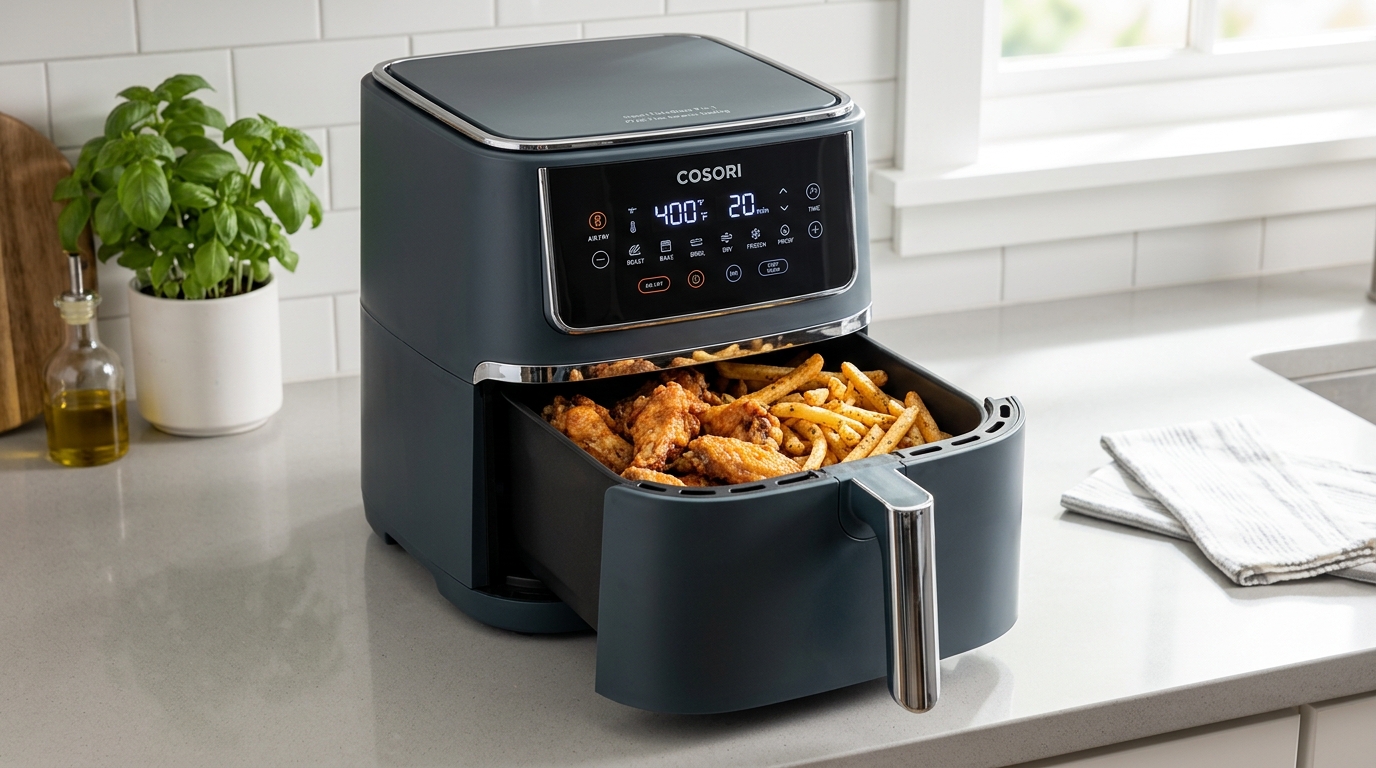
The Cosori TurboBlaze is a 6-quart air fryer oven built around a 1725-watt heating system, with an operating range that stretches from 90°F all the way to 450°F. That’s a notably wide span for a single countertop unit, theoretically letting it handle everything from slow, low-temperature dehydrating to fast, high-heat roasting within the same chamber.
The appliance is classified as a 9-in-1 model, referring to the number of individual cooking functions built into its digital control system. Its interior basket uses a ceramic coating specifically described as PFAS-free, positioning it as an alternative to the PTFE-based non-stick coatings that have historically been standard across much of the small appliance industry. Rather than functioning as a single-purpose fryer, the TurboBlaze is designed to serve as a broader countertop cooking hub, aimed at reducing the number of separate small appliances a kitchen might otherwise accumulate.
Key Features
Nine Dedicated Cooking Modes
At the heart of the appliance are nine built-in functions: Air Fry, Roast, Bake, Broil, Dry, Frozen, Proof, Reheat, and Keep Warm. Each mode is designed to automatically apply an appropriate combination of temperature, airflow, and timing, which can take a lot of the manual guesswork out of preparing unfamiliar dishes.
- Air Fry is built to crisp foods like breaded items or vegetables using fast-moving hot air.
- Roast and Bake are designed to mimic the results of a conventional oven.
- Broil applies direct, concentrated heat, generally intended for browning the surface of a dish.
- Dry is meant for slow, low-temperature dehydrating — a function commonly used for fruit, vegetables, or herbs.
- Frozen is designed to simplify cooking straight from the freezer, without requiring manual temperature calculations.
- Proof may be useful to home bakers who need a warm, stable space for dough to rise properly.
- Reheat and Keep Warm are intended to bring leftovers back to temperature or hold a finished dish without letting it dry out.
Adjustable Fan Speed, Five Levels
One of the more distinguishing details of this particular model is its five-level fan speed control. Rather than running at a single fixed intensity, the fan can be adjusted depending on what’s being cooked — gentler airflow for more delicate foods, higher airflow for items meant to come out especially crisp. A lot of entry-level air fryers skip this kind of adjustability entirely, which makes it a fairly notable inclusion here.
Broad 90°F–450°F Temperature Range
Covering such a wide temperature span is designed to let a single appliance handle both ends of the cooking spectrum. For someone trying to cut down on the number of specialized appliances cluttering their kitchen, that range could reasonably replace the need for a separate dehydrator or a dedicated high-heat oven for smaller tasks.
PFAS-Free Ceramic Basket
Instead of a standard PTFE-based coating, the basket interior uses ceramic, specifically marketed as free of PFAS compounds. This detail has become increasingly relevant as public awareness grows around synthetic non-stick chemicals and their long-term presence in cookware — a factor that shoppers researching kitchen appliances often specifically look into now.
6-Quart Capacity
At 6 quarts, the basket size generally suits smaller households best — roughly two to four people, depending on what’s being prepared and how it’s portioned. It’s a size that tends to work well for regular weeknight cooking without becoming an oversized fixture that dominates counter space.
Safety Lock
A built-in safety lock is designed to help keep the basket or door secure while the unit is actively running. This kind of feature tends to matter most in homes with young children, or simply for anyone who prefers an added layer of caution around a hot, operating appliance.
Materials and Design
Visually, the TurboBlaze follows the boxy, functional profile that’s become fairly standard across countertop air fryer ovens, where practicality generally takes priority over decorative styling. Its finish is designed to be neutral enough to fit into a range of kitchen color schemes, whether that’s a stainless-steel-heavy setup or something more muted and matte.
Inside, the ceramic coating serves as the alternative to PTFE-based surfaces found in many older or lower-cost air fryer models. Manufacturers generally choose ceramic specifically to move away from certain synthetic chemical compounds, which is a detail that continues to matter more and more to buyers paying closer attention to what their cookware and appliances are made from.
The control interface is digital, with individual buttons corresponding to each of the nine cooking functions, plus a display for adjusting time, temperature, and fan speed. This kind of button-based layout is generally intended to be approachable — letting someone select a labeled preset rather than manually calibrating settings from scratch every time.
Performance
How well an appliance like this performs largely comes down to how evenly hot air moves through the cooking chamber. The 1725-watt heating element, paired with adjustable fan speeds, is designed to support consistent heat circulation, which may reduce — though not necessarily eliminate — the need to manually shake or flip food partway through a cooking cycle.
Given the wide temperature range, the unit appears to be built with both slow, extended cooking methods and quick, high-heat ones in mind. That said, actual results will vary depending on how full the basket is, what kind of food is being prepared, and how it’s arranged inside. Conditions outside the appliance itself — kitchen ventilation, ambient room temperature, how frequently the basket gets opened mid-cook — can also play a role, so some variation between households is reasonable to expect.
Common Uses
An appliance built around this many functions tends to see use in situations like:
- Weeknight dinners, particularly when heating a full-sized oven feels excessive for a smaller portion of food.
- Reheating leftovers, often producing a firmer, less soggy texture than a standard microwave.
- Cooking straight from frozen, using the dedicated Frozen mode intended to skip manual temperature guesswork.
- Dehydrating homemade snacks, using the Dry function for things like dried fruit, vegetable chips, or jerky.
- Small-batch baking, for households that don’t want to run a full oven for a handful of cookies or a single pan of muffins.
- Proofing bread dough, which can be especially useful in cooler climates where a kitchen’s ambient temperature isn’t quite warm enough to reliably support rising.
Advantages
- Wide functional range: Combining nine cooking modes into one appliance may reduce the number of separate gadgets a kitchen would otherwise need.
- Fine-tuned airflow control: The five-level fan speed offers a degree of adjustability that isn’t always available on more basic models.
- Extended temperature span: Covering 90°F to 450°F allows the appliance to handle a broader range of recipes than single-function fryers typically manage.
- PFAS-free basket coating: This detail may specifically appeal to shoppers hoping to avoid certain synthetic non-stick chemicals in their cookware.
- Integrated safety lock: A reassuring inclusion for households with kids, or anyone who prefers extra precaution around hot appliances.
- Reasonably compact footprint: Despite offering multiple built-in functions, it remains a single countertop unit rather than several standalone devices.
Things to Consider
A handful of practical points are worth weighing before making a decision:
- Counter and storage space: Even as a single unit, a 6-quart air fryer oven can take up meaningful counter or cabinet space, so measuring available room beforehand is a reasonable step.
- Household size limits: A 6-quart capacity suits smaller households well, but larger families or bigger gatherings may need to cook in multiple batches.
- Time to learn the settings: With nine distinct modes available, new users may need some trial and error before figuring out which function suits which type of food.
- Coating maintenance: Non-stick baskets generally require gentler cleaning methods to avoid wearing down the coating over time — covered in more detail below.
- Personal texture preferences: Some people simply prefer the mouthfeel of traditional deep-fried food. Air frying can approximate a crisp exterior, but it isn’t identical to oil-based frying, and how satisfying that trade-off feels will differ from person to person.
Comparison with Similar Product Categories
Compared with basic, single-function air fryers, multi-mode ovens like this one are generally designed to provide broader versatility — folding roasting, baking, dehydrating, and proofing into the same unit as standard air frying. Simpler models tend to stick to frying alone and often skip features like adjustable fan speed or an extended temperature range entirely.
Set against full-sized convection ovens, countertop air fryer ovens are typically more compact and tend to preheat faster, thanks to their smaller internal chamber. Full ovens, on the other hand, generally provide more usable capacity, which matters more for larger households or bigger batch cooking.
Compared to dedicated food dehydrators, an air fryer with a built-in Dry function may offer more convenience by removing the need for a separate appliance altogether, though standalone dehydrators sometimes provide more surface area for drying larger quantities in a single session.
Ultimately, which category fits best comes down to available kitchen space, household size, and how many distinct cooking methods a person actually relies on regularly.
Maintenance and Care
Keeping up with routine maintenance can help extend an air fryer’s lifespan while protecting the quality of its non-stick surface. General care practices for this type of appliance typically include:
- Letting the unit cool fully before cleaning, both to protect the coating and avoid injury.
- Hand washing the basket using a soft sponge and mild dish soap rather than abrasive scouring pads, which can wear down ceramic coatings faster than expected.
- Wiping down the exterior with a damp cloth to remove grease or splatter, avoiding harsh chemical cleaners that could affect the finish.
- Periodically checking the heating element area for stray food debris, since buildup there can interfere with airflow and cooking consistency over time.
- Drying all components fully before reassembling or storing the unit, to help prevent trapped moisture.
- Storing it in a dry location, ideally with the basket removed or the lid left slightly open, letting the unit air out and reducing the chance of lingering odors.
Following the manufacturer’s included instructions generally remains the safest way to maintain both performance and safety throughout the appliance’s lifespan.
Frequently Asked Questions
1. What household size does this air fryer suit best? A 6-quart capacity is generally well suited to small or medium households, roughly two to four people, though this depends on the type of food and portion sizes involved.
2. Could this appliance replace a full-sized oven entirely? It may cover a number of smaller cooking tasks well, but it isn’t necessarily designed to fully replace a full oven, particularly for larger-quantity cooking.
3. How does the ceramic coating differ from standard non-stick surfaces? Ceramic coatings are typically formulated without PFAS compounds, offering an alternative to the traditional non-stick materials used in many other appliances.
4. What exactly does the Proof function do? It’s designed to hold a low, steady temperature that may support dough rising, which can be useful for bread or pizza preparation.
5. Is preheating required before cooking? This can vary by recipe and food type, so checking the included instructions or a specific recipe’s guidance tends to be the more reliable approach.
6. Can frozen food go directly into the basket without thawing first? The dedicated Frozen setting is built for that exact purpose, potentially reducing the need for manual temperature adjustments.
7. How many fan speed levels does this model offer? There are five adjustable fan speed levels, intended to give more precise control over airflow depending on the food being prepared.
8. Is a safety lock actually necessary on an air fryer? It isn’t essential for every household, but it can be a valuable addition for families with children or anyone who prefers extra security during operation.
9. What’s the highest temperature this unit can reach? It goes up to 450°F, designed to support higher-heat cooking methods like roasting or broiling.
10. Does cleaning the basket require any special tools? A soft sponge paired with mild dish soap is generally recommended; abrasive tools are typically discouraged, since they can damage the ceramic coating over time.
11. Is this appliance capable of dehydrating food? Yes — the Dry function is specifically designed for dehydrating items like fruit, vegetables, or homemade snacks at lower temperatures over an extended period.
12. Does this appliance need special kitchen ventilation? As with most countertop cooking appliances, reasonable airflow around the unit is advisable, along with whatever standard kitchen ventilation practices are already in place.
Final Thoughts
The Cosori TurboBlaze 6 Qt fits squarely into a broader movement toward multi-functional, space-conscious kitchen appliances. By combining nine cooking modes, a wide temperature range, and adjustable fan speeds into a single countertop unit, it’s designed to give households more flexibility in how they cook without needing to add several separate appliances to their kitchen.
As is generally true of countertop cooking equipment, how well this particular model fits any given household depends largely on individual cooking habits, family size, and the amount of available counter space. Reviewing the manufacturer’s specifications and instructions ahead of time can help set realistic expectations before use.